
So, you’re thinking about joining the 3 million Americans who have already opted for dental implants to fix their smiles (according to 2024-2025 industry data). It’s an exciting move! But as you look at those sleek titanium posts, a nagging question might pop up: “Will this new ‘iron tooth’ be a good neighbor to my natural teeth and gums, or is it going to stir up trouble?”
It’s a fair concern. After all, your mouth is a delicate ecosystem. Adding a bionic resident to the neighborhood is bound to change things. Whether you’re missing a single tooth from a weekend pickleball mishap or you’re looking at a full-arch restoration, understanding the “ripple effect” of implants is key to long-term success.
In this guide, we’re diving deep into the data, the biology, and the local reality of dental implants in the U.S. to see how they really affect your oral health.
How Implants Protect Your Mouth
For decades, the standard for a missing tooth was a dental bridge. The problem? To place a bridge, a dentist has to grind down the healthy adjacent teeth to serve as anchors. It’s a bit like tearing down two perfectly good houses just to build a porch for a third.
Preserving Your Natural Structure
Dental implants are the only restoration option that doesn’t require “reducing” neighboring teeth. According to the American Academy of Implant Dentistry (AAID), implants are a “stand-alone” solution. This means your natural teeth stay 100% intact, preserving their enamel and structural integrity.
Preventing the “Domino Effect.”
When you lose a tooth, the surrounding teeth eventually start to “tip” or drift into the empty space. This misalignment can lead to:
- Malocclusion (bad bite)
- Increased risk of decay (due to new, hard-to-clean gaps)
- Jaw pain (TMJ issues)
Research indicates that implants act as a “placeholder,” maintaining the exact alignment of your dental arch and protecting the lifespan of the teeth you still have.
Bone Health: Use It or Lose It
This is where the stats get interesting. Within the first year of losing a tooth, you can lose up to 25% of the bone density in that area of your jaw. Implants are the only tooth-replacement option that stimulates bone growth through a process called osseointegration. By mimicking a natural tooth root, the implant signals to your body, “Hey, we’re still using this bone!” which helps prevent the sunken-face look often associated with long-term tooth loss.
Potential Impacts on Gums and Teeth
While implants have a staggering 95% to 98% success rate in the U.S., they aren’t “set it and forget it.” They do change the dynamics of your mouth, and if not monitored, they can cause a few headaches for their neighbors.
The Threat of Peri-Implantitis
While an implant can’t get a cavity (titanium is immune to sugar!), the gums around it can still get “gum disease.” This is known as peri-implantitis.
- Prevalence: Recent studies published in PubMed suggest that roughly 1/3 of patients and 1/5 of all implants may develop peri-implantitis over time.
- The Impact: If the gums around an implant become inflamed, that infection can spread to the gums and bone supporting your natural teeth.
Biomechanical Stress
Natural teeth are suspended by a tiny “cushion” called the periodontal ligament, which allows for microscopic movement. Implants, however, are fused directly to the bone. They don’t budge.
- The Risk: Because implants lack a “shock absorber,” they can sometimes transmit more force to opposing or adjacent natural teeth during chewing. If the “bite” isn’t perfectly calibrated by your dentist, it can lead to micro-fractures or increased wear on your natural pearly whites.
Proximal Contact Loss
A 2024 study published in the Journal of Oral Rehabilitation found that, over time, natural teeth tend to move forward (mesial drift), while the implant remains stationary. This can create a tiny gap between the implant and the natural tooth, leading to food impaction.
Data Point: If these gaps aren’t managed, the risk of “secondary caries” (cavities) on the adjacent natural tooth increases significantly.
Why Should You Care About?
Knowing the risks (even the rare ones) helps you:
- Ask better questions at your dental consultation
- Understand the importance of planning and imaging before surgery
- Recognize early signs of trouble so you can act quickly
- Stick to follow-up care for the best long-term outcomes
Here’s what your dentist or oral surgeon typically evaluates before recommending an implant:
- Gum and bone health
- Bite stability and tooth alignment
- Presence of gum disease or infection
- Overall oral hygiene habits
- Smoking status
All these factors influence success.
How to Keep the “Neighborhood” Healthy
To ensure your implant and your natural teeth live in harmony, U.S. dental experts recommend a specific maintenance routine:
- Use an Interdental Brush: Standard floss is great, but “proxy brushes” are better at reaching the unique contours where an implant meets the gum line.
- Low-Abrasive Toothpaste: Avoid “whitening” pastes with heavy grits that can scratch the restoration or irritate the sensitive peri-implant tissue.
- Night Guards: If you’re a “grinder” (bruxism affects about 10% of U.S. adults), a night guard is mandatory. Since implants don’t have nerves, you won’t feel the pressure, but your natural teeth certainly will.
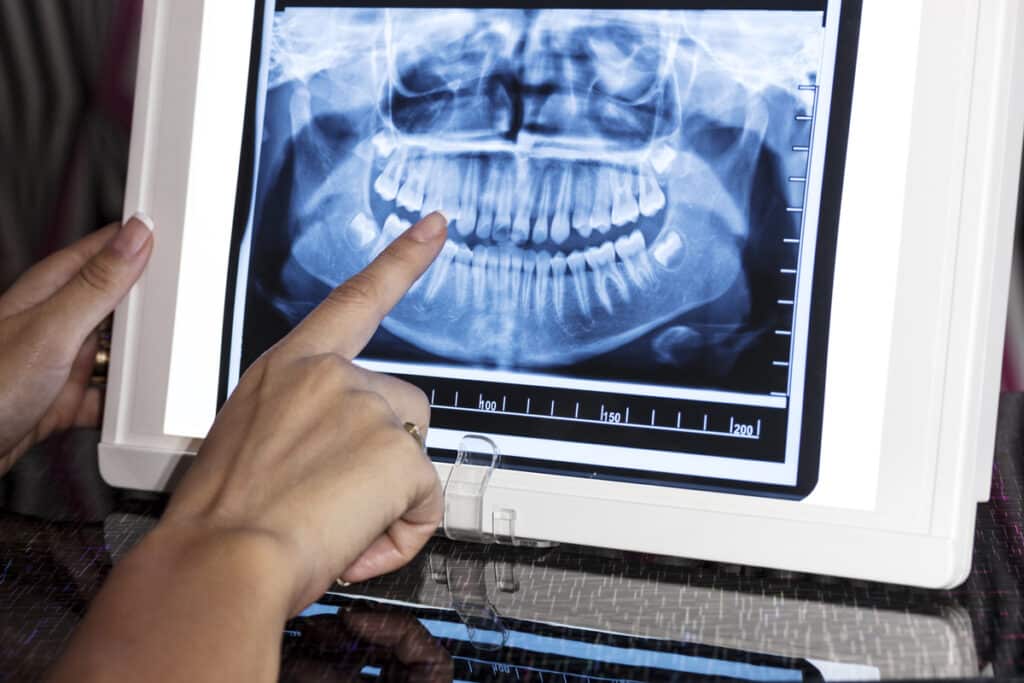
- Regular Radiographs: Your dentist should take X-rays at least once a year to monitor bone levels around the implant to catch any “silent” bone loss early.
- Schedule Regular Cleanings: Professional cleanings help catch early signs of gum inflammation or adjacent tooth problems.
- Avoid Smoking: Studies show that smoking can double or triple the risk of implant failure and gum disease.
- Treat Gum Disease Before Implants: Active periodontal issues should be stabilized before implants are placed.
- Ask About Imaging Tools: 3D imaging (such as CBCT) helps your dentist plan implant placement with millimeter precision, reducing the risk of damage to adjacent teeth.
Common Misconceptions
Before we wrap up, let’s clear up a few myths:
Myth: Implants weaken nearby teeth.
Fact: Implants can stress adjacent teeth if poorly placed, but when done properly with good planning, they often help preserve jaw structure and prevent drifting of neighboring teeth.
Myth: Gum disease is impossible once you have implants.
Fact: Peri-implantitis exists — good gum care is still essential.
Myth: Implants last forever without maintenance.
Fact: With excellent care, implants can last decades — but maintenance is crucial to prevent complications.
Conclusion
So, can dental implants affect your teeth and gums? Absolutely—but mostly for the better. By stopping bone loss and preventing your other teeth from shifting, implants serve as the ultimate “anchor” for your oral health. While risks such as peri-implantitis and bite stress exist, they are highly manageable with a modern dental hygiene routine and regular checkups.
Think of an implant as a high-performance upgrade for your mouth. It requires a bit of specialized “oil changes” (professional cleanings), but the payoff is a smile that stays aligned, strong, and functional for a lifetime.
Frequently Asked Questions
1. Can dental implants cause gum disease around natural teeth?
Yes — if plaque accumulates around the implant or inadequate hygiene allows bacteria to build up, it can lead to peri-implantitis, which may affect the gums around adjacent teeth.
2. Do implants weaken nearby teeth?
Implants themselves don’t inherently weaken adjacent teeth, but poor placement or infection can stress those teeth and increase the risk of fractures or mobility.
3. How soon after getting an implant should I see my dentist?
Follow-ups usually occur within a week after placement, then periodically during healing—at least every 3–6 months—to monitor gum and bone health.
4. Are dental implants safe for people with gum disease?
Gum disease should be treated and well-controlled before implant surgery to reduce the risk of complications.
5. What’s the average lifespan of a dental implant?
With excellent care, dental implants can last 20+ years and often a lifetime—but that depends on oral hygiene, lifestyle, and regular dental visits.