
A Revolutionary Treatment for Replacing Missing Teeth
Dental implants are a relatively recent treatment for replacing missing teeth, having only been in use for a few decades. While they are newer than bridges and dentures, they have grown significantly in popularity. Implants involve the use of small titanium posts, which are surgically inserted into the jawbone. The bone then fuses to the posts in a process known as osseointegration. This process turns the implants into strong, stable roots that are then used to support ceramic crowns.
The Dental Implant Process
Getting your dental implants involves a surgical procedure. A local anesthetic and sedation are administered before the procedure begins. When they have taken effect, small incisions are cut in the gum tissue, exposing the bone. Small holes are then drilled into the jawbone, and the implants are placed inside. The gums are stitched closed around the implants, and temporary teeth are placed. Healing from implant surgery can take up to several months.
During this time, the bone fuses with the implants, integrating them into your jaw. Our Winchester dentist monitors this progression closely to ensure it goes smoothly. Once you have fully healed, our dentist, Dr. Jared Pell, will remove the temporary teeth and take impressions of your mouth. The impressions are sent to a dental lab where your new crowns are created. When they are ready, our dentist in Winchester, VA screw them into place on your implants, and you leave with a fully functioning, completely natural-looking, new smile.
Dental implants look, feel, and function just like your natural teeth, right down to stimulating your jawbone to keep it healthy and strong. If you are missing teeth, visit our dental office, Shenandoah Family Dentistry at 540-773-0234 to find out if dental implants are the right solution for you.
Customized Treatment for Your Needs
Dental implants in Winchester are unique in many ways. One way is that they can be customized to meet a variety of needs. Whether you are missing a single tooth or you are missing all of your teeth, there is a dental implant for you.
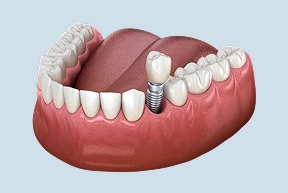
Single Tooth Implants
A single-tooth implant uses a single titanium post to support a crown, replacing a single missing tooth in any area of the mouth.
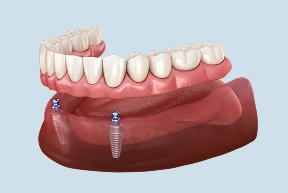
Multiple Tooth Implants
Also called an implant-supported bridge, this implant replaces two or more teeth in a given area. One or more implants support your crowns.
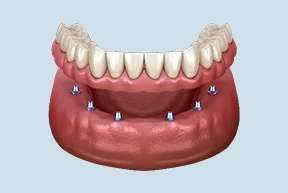
Implant-Supported Dentures
An implant-supported denture uses 6 to 8 implants to support an entire arch of new teeth.
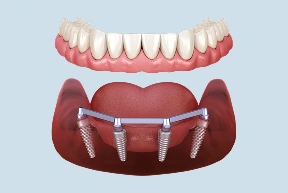
All-on-4® Treatment Concept Implants
This treatment is an alternative to implant-supported dentures and may be considered when bone loss limits traditional implant options.
The All-on-4® Treatment Concept uses four strategically placed implants to leverage the bone mass you do have. With this treatment, you can avoid the need for a bone graft before getting your implants.
Book A Online ConsultationFrequently Asked Questions About Dental Implants
Can I get a dental implant if I have bone loss?
Bone loss does not always rule out dental implants. The amount and location of available jawbone must be evaluated before treatment. For some patients, the All-on-4® Treatment Concept uses four strategically placed implants to make use of existing bone and may avoid the need for bone grafting.
What happens if I leave a missing tooth untreated?
A missing tooth can affect chewing, speech, and the appearance of the smile. Over time, the jawbone in that area can weaken because it no longer receives stimulation from a tooth root. Nearby teeth may also shift toward the open space.
What is osseointegration, and why does it matter?
Osseointegration is the process in which the jawbone fuses with a titanium implant post. This healing stage creates the stable foundation needed to support a crown, bridge, or full-arch restoration.
Can dental implants replace a full arch of teeth?
Yes. Implant-supported dentures can replace a full upper or lower arch using multiple implants. Shenandoah Family Dentistry also offers the All-on-4® Treatment Concept, which supports a full arch with four implants placed at planned angles.
Will I have teeth while my dental implants heal?
Temporary teeth may be placed after implant surgery while the jawbone heals. Once osseointegration is complete, impressions are taken so the dental lab can create the final crowns or replacement teeth.
How long does healing take after dental implant surgery?
Healing from dental implant surgery can take several months. This period allows the jawbone to integrate with the implant posts. Shenandoah Family Dentistry monitors healing progress before moving forward with the final restoration.
Do dental implants feel like natural teeth?
Dental implants are secured in the jawbone rather than resting on the gums. Once restored with crowns or replacement teeth, they are designed to support biting, chewing, and speech while providing a stable, natural-looking tooth replacement.
What happens if an implant does not heal properly?
Successful implant treatment depends on healthy healing between the bone and implant. If an implant does not integrate as expected, the treatment plan must be reassessed before the final restoration is placed. A detailed evaluation at Shenandoah Family Dentistry in Winchester helps identify the implant option that fits your oral health and bone support.